

“I Didn’t Even Realise I Was a Carer”: What Being a Young Carer is Really Like

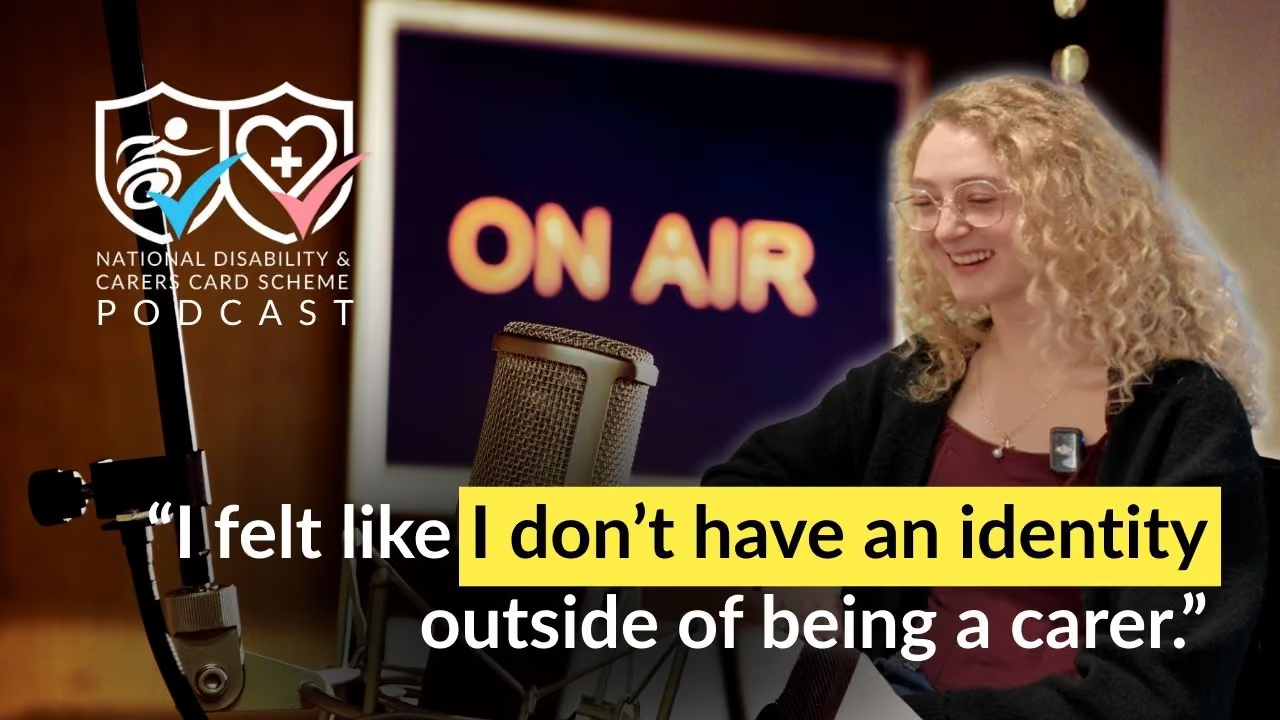
As part of our interview series, we speak to interesting people about their lived experiences of disability and caregiving. In this episode we hear from Cici, founder of Seeing Dementia Differently, about becoming a young carer, navigating university with a parent who had rare dementia, and the lasting impact caregiving has had on her identity. Please note the content of the podcast has been abridged and paraphrased for readability. You can watch or listen to the full podcast using the links below.
Can you tell us a bit about your story?
My story really starts when I was 11. My dad was diagnosed at 54 with a rare, young-onset form of dementia called posterior cortical atrophy (PCA). At first, there wasn’t much my brother or I could do to help. Dad was still working, driving, and mostly independent.
But over the next few years, things gradually changed. He’d veer into the wrong lane while driving and not realise. He’d reach for objects that weren’t where he thought they were. PCA affects visual processing and coordination before memory, which a lot of people don’t realise.
By the time I was 14 or 15, I was helping with medication, personal care, and making sure my younger brother was ready for school. My mum continued working because financially that was the best option for us. I didn’t think of myself as a “carer” at the time — I just thought I was helping.
It wasn’t until I went away to university that I looked back and realised, I’ve actually been a carer this whole time.
Was there a specific moment when you identified as a carer?
It was gradual. I think I realised it properly when I moved to Edinburgh for university. Being away from home gave me perspective. I also met a close friend whose dad had a rare form of dementia. When she described herself as a carer, something clicked. I thought, “Oh… maybe I’m a carer too.”
Before that, I think I downplayed it because my mum was the primary carer. In my head, I couldn’t claim that label. But once I reflected on the responsibilities I’d taken on, I realised I did need support too.
I think that struggle to identify as a carer is really common — especially in families. My mum didn’t initially see herself as a carer either. She saw herself as a wife looking after her husband. It was only after attending support groups that she began to recognise her role and register for support.
Would earlier recognition have made a difference?
Definitely. Because Dad had a rare form of dementia, there was very little information available at the time. Even basic explanations of PCA were hard to find. The advice we were given was generic dementia advice — often focused on memory — but Dad’s early symptoms weren’t memory-related at all. They were visual and coordination-based.
I think what was missing was someone pulling the whole family aside after diagnosis — especially where there are children involved — and explaining what to expect, what caring might look like, and what support is available.
What about support specifically for young carers?
Support for young carers is complicated. When I worked in dementia support, I wanted to create a young carers programme, but there’s a lot of red tape when working with under-18s. Consent becomes tricky, especially if the parent has cognitive impairment.
There are carers groups, but they’re often geared towards adults. There’s also confusion between “young carers” and “young adult carers.” I’ve gone to events expecting to meet teenagers and found the “young carers” were in their 30s. Those are very different experiences.
Another issue is that information often gets directed at parents, with the assumption they’ll pass it on. But what if the parent isn’t engaging with that information? What if the young person wants to understand the diagnosis more deeply? There needs to be something directly accessible to young carers themselves.
How did you cope during those early years?
I did a lot of research — very neuroscience-based research. Understanding what was happening in Dad’s brain helped me find practical adaptations. For example, people with PCA can often see colour better than shapes, so we used bright tape on door handles and objects to give him more independence. That reduced stress for all of us.
I also searched online for other people’s experiences. The overriding feelings for me were isolation and loneliness. Even with family support, it felt like none of my peers understood what I was going through.
Music helped a lot. Dad loved music, and we’d use playlists to lift his mood or calm difficult moments. For me personally, talking openly about being a carer became the biggest coping mechanism.
Once I accepted that identity and started saying, “I’m a carer and these are my responsibilities,” it became easier for others to understand my situation.
How did your experience of caregiving affect your life more broadly?
Because I didn’t have the support I wish I’d had when I was younger — and because I didn’t even fully realise I was a carer until later — it had quite a negative impact on my mental health. Even after my dad passed away, I struggled to separate my identity from caregiving. When I was still working with people who had his diagnosis, it felt incredibly heavy. I started to feel like being a carer was the only thing I knew how to be.
That mindset followed me into other relationships too. I noticed I was always taking control — planning everything, making sure everyone was okay, anticipating problems before they happened. That’s what I’d done for years at home.
It took me a long time to understand that caring can be part of who I am, but it can’t be my entire personality. If it is, you end up giving so much of yourself away that there’s nothing left for you.
At the same time, caring shaped me in positive ways. I’m more patient and understanding than I think I would have been otherwise. I’m more aware that you never really know what someone else is dealing with. There are skills I developed that I’m genuinely grateful for. But I do think, especially for young carers, you have to be careful not to let that role define you completely while you’re still forming your identity.
It also affected my boundaries. For example, if a friend cancels plans three or four times, I might be very lenient. In my head I’m thinking, I’ve had to cancel before because Dad suddenly needed something — I understand. So I say, “It’s okay, don’t worry.” But then I realised my kindness was sometimes being misread as: Cici doesn’t mind. She’ll adapt. She’ll always be fine. People start making backup plans with you because they assume you won’t be bothered either way.
And the truth is — I do mind. I’m just trying not to make them feel bad.
That’s when it hits you: Where are the accommodations for me? When is someone going to show up for me when I’m having a really hard day? I had always tried not to put the chaos and grief I was going through onto other people, and yet I made allowances for others who might be doing that.
Do you hear similar themes from other young carers?
A big theme I hear is not wanting to share what’s happening, because you want to be seen as strong — capable — like you’re managing it all.
If you open up and say, “I’m struggling and I need support,” it’s uncomfortable. And sometimes, when I asked for help, I got pushback that made me feel like I shouldn’t ask again.
There’s also the fear of being the “weak link” in the family. You think: Everyone else is coping — why can’t I?
But often, once families actually talk, you realise everyone is feeling the same way — and nobody wants to add to anyone else’s load. That’s why conversations matter, so you can divide roles more fairly.
I know some young carers who use a simple timetable system — “on shift, off shift” — so one person in the family gets to go out while another stays home. Tools like that can really help.
Care can be heavy — but were there moments of joy too?
Absolutely. The more I understood PCA, the easier it became to communicate with Dad. For a while it felt like we were stuck in a loop: I didn’t know the best way to talk to him, and he didn’t know what support to ask for. Once we understood how his language and vocabulary were changing, we could adapt — we even talked about creating a little “dictionary” for him. That shifted things back towards connection, rather than constant stress.
Later on, when Dad moved into a care home, visits became easier in a strange way. His basic needs were being met, so we didn’t have to rush around doing tasks. We could be there for the emotional part — holding his hand, watching a film, putting on music.
And he had lucid moments — sometimes a few minutes, sometimes a couple of hours. Those moments were incredible. They were heartbreaking when they faded — but they were also beautiful.
Was it hard to separate caring tasks from quality time?
Yes — because sometimes you think you’re spending time together, but then you reflect and realise it wasn’t really quality time.
It might be me trying to do something while Dad sits next to me, because it’s easier to keep an eye on him. Neither of us is enjoying it — it’s just survival.
What helped was having day carers come in. It meant I wasn’t coming home from school and immediately going into “task mode” — checking he’d eaten, making tea, getting him settled — before even starting homework.
Instead, I could come home and join him at the end of a film, share a calm moment, and then do what I needed to do. It created clearer “quality time,” rather than constant monitoring.
Tell us about life after caring — and what you’re building now.
I’m definitely adventurous — I love adrenaline sports: bungee jumping, skydiving, wing walking — all of it. Recently I’ve been doing more of those challenges to raise money for dementia charities, which has been really rewarding.
People often leave messages with their donations, sharing memories of my dad. And that’s been really special, because I’m still learning things about him even now.
Travel has also been a big part of my life. When I was 15, I started going away for volunteer projects — places like South Africa, Belize, and parts of South America. Looking back, with help from a therapist, I realised it was also a way of escaping the heaviness at home for a while.
But I can reframe it now: I learned skills that helped me as a carer too — like communicating differently when you don’t share a language, which later translated into adapting how I communicated with Dad as his language changed.
And now, I've created Seeing Dementia Differently. The goal is to build community and practical resources — especially for young dementia carers, who often don’t have age-appropriate spaces to turn to.
Long-term, I want to train in counselling and psychotherapy, so I can support families after diagnosis and help young carers understand their role earlier.
I’m also developing tools — like a planner for young carers — because not everyone has a parent who can leave detailed lists and schedules. Some young carers are managing a household without that structure, and they deserve something designed for them.
I’ll also be working with schools and young carers networks to raise awareness of rare dementias. Many are young-onset, which means children are often affected — and they shouldn’t have to explain everything from scratch every time.
Was there anything you feel you missed out on as a young carer?
Missing out is common for young carers — parties, events, the normal teenage stuff.
But for me, the biggest shock was recently finding out that I’m autistic and have ADHD. It was missed when I was younger, and a lot of it was put down to “stress at home.”
It took me a long time to even book the assessment, because I kept thinking: Surely someone would have noticed. But looking back, there were clear signs — like meltdowns at school if something on my desk was moved, or communication misunderstandings that made people think I was being rude when I didn’t realise.
So much got misattributed — to carer stress, anxiety, depression — and no one explored neurodivergence until very recently. There’s grief in that. It feels like starting from scratch and figuring out who you are.
But there’s also relief — because finally, there’s an explanation. And now I can use resources that actually fit, rather than trying strategies for depression that never really worked for me.

|

|

|
Follow Seeing Dementia Differently:
About the National Carers Card
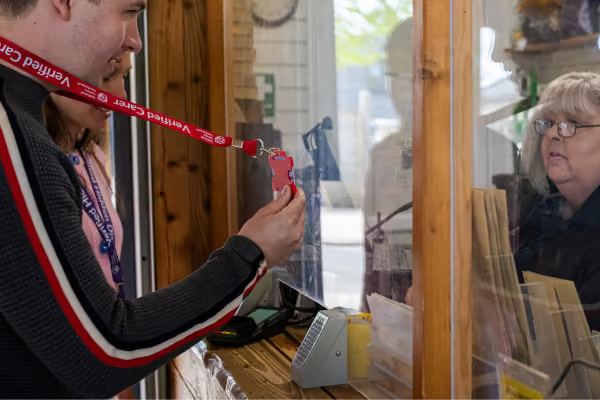
The National Carers Card is a form of visual identification for carers across the UK. Designed to support and acknowledge the invaluable role of carers, the card helps with accessing services, discounts, and other benefits that make daily life a little easier. Founded by carers in 2019, the National Carers Card is part of a social enterprise for good dedicated to supporting carers and their families.
Conclusion
Share

.avif)

