The Complete Guide to Attendance Allowance for Carers


If you care for someone over State Pension age, Attendance Allowance could make a real difference to their finances, and to yours. This guide explains how much it pays, who qualifies, how it differs in England, Scotland, Wales and Northern Ireland, and which other benefits you can claim alongside it.
What is Attendance Allowance?
Attendance Allowance helps with the extra costs of a disability or health condition severe enough that someone needs help looking after them, or supervision to stay safe. It is for disabled people over State Pension age, and can be claimed by the disabled person whether or not they use professional care.
It is paid at two rates: the lower rate is for frequent help or constant supervision during the day, or supervision at night. The higher rate is for help or supervision throughout both day and night, or for someone who is nearing the end of their life.
How much is Attendance Allowance per month?
For 2026/27 the lower rate is £76.70 a week, while the higher rate gives you £114.60 a week. Payments are usually made every four weeks, which works out at £306.80 or £458.40 per payment. Averaged across a calendar month, that is roughly £332 at the lower rate and £497 at the higher rate.
The rates are the same whether you live in England, Scotland, Wales or Northern Ireland. If the person you care for starts out claiming the lower rate but their needs change, you can report this change and have the rate upgraded.
PIP, DLA, Attendance Allowance rates compared
Attendance Allowance is granted at the same rate as the PIP daily living element, although there is no equivalent of the mobility element.
- Attendance Allowance: £76.70 (lower) and £114.60 (higher). There is no mobility element.
- PIP: the daily living rates are the same at £76.70 (standard) and £114.60 (enhanced), although depending on your needs you can also claim the mobility element at £30.30 (standard) or £80.00 (enhanced).
- DLA care component: from £30.30 (lowest) up to £114.60 (highest), with a separate mobility component.
Please note that you can't receive Attendance Allowance at the same time as PIP or Disability Living Allowance. If the person you care for already gets PIP or DLA when they reach State Pension age, they can usually keep it, whereas new applicants are routed towards Attendance Allowance.
Is Attendance Allowance means tested or taxable?
Attendance Allowance is not means tested, so income, pensions and savings do not affect whether it is awarded. You won't be taxed on the Attendance Allowance you receive.
What medical conditions qualify for Attendance Allowance?
What qualifies a person for Attendance Allowance is not their diagnosis alone, but how their condition affects daily life: whether the disabled person needs help with things like washing, dressing, eating, taking medication or using the toilet, or needs supervision to stay safe.
In order to start claiming Attendance Allowance, you must have needed this help for at least six months, although please note that where someone is terminally ill, the six-month wait doesn't apply.
Attendance Allowance in Scotland: what has changed?
In Scotland, Attendance Allowance has been replaced by Pension Age Disability Payment (PADP), run by Social Security Scotland rather than the DWP. The rates are the same as Attendance Allowance, and it is not means tested. These are the main Attendance Allowance Scotland changes to know about:
- PADP opened across Scotland on 22 April 2025, and existing Attendance Allowance awards were moved over automatically, with no need to reapply. The transfers were due to be complete by the end of 2025.
- Terminally ill people get the higher rate with a faster process, whatever their life expectancy. The DWP applies its terminal illness rule only if someone is expected to live 12 months or less.
- Face-to-face help with applications is available through Social Security Scotland, and independent advocacy is available through Voiceability.
- Carers of someone on PADP may be able to claim Carer Support Payment instead of Carer's Allowance.
- If you move between Scotland and the rest of the UK, you must tell the relevant agency and make a new claim. Attendance Allowance stops 13 weeks after a move from England or Wales to Scotland.
Anyone who already gets Adult Disability Payment stays on it after reaching State Pension age, rather than moving to PADP.
Does Attendance Allowance differ in England, Wales and Northern Ireland?
England and Wales are treated the same: you apply to the DWP using the online service or a paper form, and the rules and rates are identical. Northern Ireland has the same rates and similar rules, but claims go through the Department for Communities' Disability and Carers Service and nidirect, and a claim normally takes around 30 working days to process.
What other benefits can I claim with Attendance Allowance?
Attendance Allowance does not reduce other benefits, and it can increase them. According to GOV.UK, the person receiving it could get extra Pension Credit, Housing Benefit or Council Tax Reduction, so it is worth asking each provider.
For you as a carer, the main benefit is Carer’s Allowance, currently £86.45 a week. It is usually available if you care for someone for at least 35 hours a week and they receive a qualifying disability benefit such as Attendance Allowance, and you must also meet the earnings limit. Carers on Universal Credit may be able to claim the carer element instead.
Things you cannot combine: Attendance Allowance cannot be paid alongside PIP, DLA or Adult Disability Payment, and it is reduced if the person also receives Constant Attendance Allowance.
💡 Read our guides to how much Carer's Allowance is and what other benefits you can claim as a carer.
Attendance Allowance pitfalls to avoid
A few common mistakes can cost families money:
- Under-explaining on the form. Many claims are refused because the form does not make clear how the condition affects daily life. Describe the worst days and add supporting evidence such as GP letters or care plans.
- Getting the claim date wrong. If you phone for a paper form, the date of your call can count as the start of the claim as long as you return it within six weeks. Downloading it yourself may delay your first payment.
- Care homes and hospital stays. Payments usually stop after 28 days in an NHS-funded hospital stay, or if the local authority or NHS Continuing Healthcare pays for a care home. Self-funders can usually keep it.
- Going abroad. Stays abroad of under 13 weeks are generally fine, or under 26 weeks for medical treatment. Longer trips can affect payment.
- Not reporting changes. Tell the DWP (or Social Security Scotland or the Disability and Carers Service) if the level of care needed, or where the person lives, changes.
- Carer’s Allowance side effects. Claiming Carer's Allowance can affect extra amounts paid within the other person's means-tested benefits, so ask for a benefits check before you apply.
If a claim is refused, you can ask for the decision to be looked at again and appeal.
How to claim Attendance Allowance
In England and Wales, apply online through GOV.UK, or call the helpline on 0800 731 0122 (Monday to Friday, 8am to 6pm) to request a paper form. Have the person's National Insurance number, address, GP details and information about their condition to hand. You should get a text or letter within three weeks explaining when to expect a decision.
In Scotland, apply for PADP through Social Security Scotland. In Northern Ireland, use nidirect or request a claim pack from the Disability and Carers Service.
If the person is nearing the end of life, a separate, faster route applies. There is no six-month qualifying period, claims are dealt with more quickly, and the higher rate is paid from the start. Ask for the end-of-life route when you call, or see the GOV.UK end-of-life guidance, nidirect in Northern Ireland, or Social Security Scotland's terminal illness process.
How the National Carers Card can help
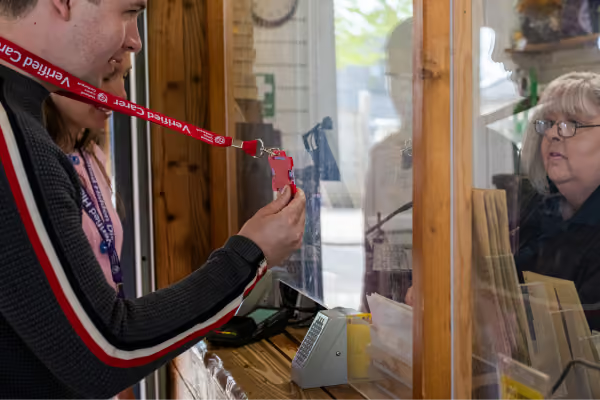
Benefits help with the basics, and the National Carers Card helps with everyday costs and access. It gives you easy-to-carry proof of your caring role, so you can access carer concessions and exclusive discounts without explaining your situation each time.
💡 Apply for your National Carers Card today
About the National Disability & Carers Card Scheme
The National Disability & Carers Card scheme was set up in 2019 by carers to make everyday life and access easier for people with disabilities and those who care for them. The scheme supports 300,000 card holders and provides easy-to-carry visual identification that helps people avoid repeatedly explaining their disability or caring role. The National Disability Card is accepted as proof of disability at 600+ venues across the UK and abroad.
Conclusion
Share